

Agent, harness, and platform
| Layer | Responsibility | Clarivy surface |
|---|---|---|
| Agent | Perceive authorized case data, plan within policy, call approved tools, observe results. | Case AI dock and specialist team roles |
| Harness | Governed runtime for state, tool calls, memory scopes, citations, evals, and human review. | ClarivyLLMHarness and /cases/{id}/ai/* |
| Platform | Multi-tenant identity, durable execution, cost controls, and tenant-filtered retrieval. | Tenancy, Postgres/SQLite audit, object storage, Qdrant filters |
Decision authority
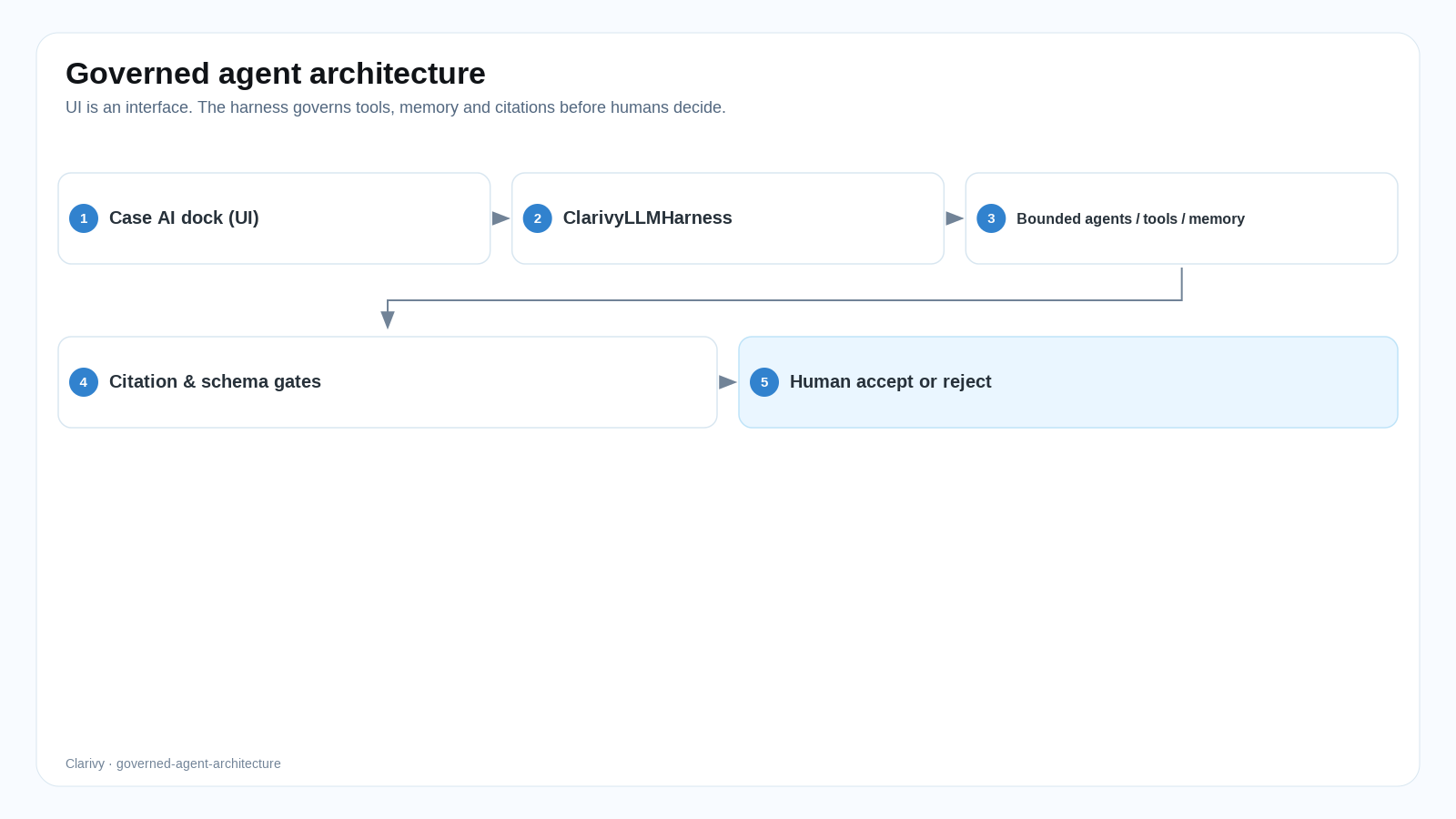
The case AI dock is an interface, not the architecture. Every recap, chat, gap, extraction, and team action routes through one harness contract. Clarivy prepares source-cited work; named humans own material outcomes. MongoDB is not required for this design, Postgres remains authoritative state and audit.
Controlled AI review
Document intelligence pipeline
Governed specialist team
| Specialist | Bounded responsibility | Control boundary |
|---|---|---|
| Citation verifier | Extract supported claims and verify exact source quotes. | Cannot use another tenant or application. |
| Gap planner | Identify missing, stale, rejected or contradictory material. | Creates review work; cannot change policy or request data alone. |
| Packet composer | Draft a cited review summary and decision-packet narrative. | Cannot approve, reject or close the application. |
| Quality sentinel | Check validation failures, citations and signed activity lineage. | Blocks unsafe output; never repairs it silently. |
Server-side orchestration
The agent team is started as one persisted orchestration run. Clarivy executes the ordered specialist tasks on the server, records every child run and stops when a control fails. All successful proposals still require named human review.
Seven control gates
- 1
Authorize the context
Load the case using the authenticated tenant and limit selection to evidence already attached to that case.
- 2
Minimize identifiers
Replace common direct identifiers in the temporary model context without mutating authoritative evidence.
- 3
Use a versioned task contract
Bound the task, context, output length, prohibited actions and required human review.
- 4
Route to an approved provider
Use a local, private or customer-approved managed provider. Remote processing is disabled unless explicitly permitted.
- 5
Validate the structure
Reject unknown fields, missing fields, placeholders or output that does not match the strict schema.
- 6
Verify every citation
Confirm that evidence IDs belong to the case and exact quotes occur in the supplied source.
- 7
Require human review
A named user accepts or rejects the assistance with a reason. Acceptance does not silently create evidence.
What the model may and may not do
| Allowed assistance | Prohibited action |
|---|---|
| Extract source-supported fields | Invent or silently correct a material value |
| Summarize approved case evidence | Browse beyond the authorized case boundary |
| Identify possible gaps or contradictions | Turn uncertainty into a customer risk score |
| Prioritize review tasks | Approve, reject or close a material gate |
| Draft cited reviewer text | File an STR/SAR or trigger recovery action |
Machine-learning capabilities
| Capability | Model signal | Reviewer control |
|---|---|---|
| Multilingual entity resolution | Name embeddings or deterministic multilingual similarity, official identifiers, address and country | Shows the weighted contribution of every feature; conflicting identifiers block a match and records are never merged automatically |
| Document intelligence | OCR text, page-linked field candidates, document class and extraction confidence | The original file and page remain visible; a reviewer confirms or corrects each material field |
| Contradiction and gap prioritization | Differences across cited case evidence and policy-required proof | Creates review work and keeps both claims visible; it does not turn uncertainty into customer risk |
| Controlled case assistance | Schema-bounded extraction, summaries and gap analysis over authorized case evidence | Every quote is checked against a case source and the output needs a named acceptance or rejection |
Compare two legal-entity records
Entity resolution is designed for candidate matching across a case record, company registry, sanctions or PEP screening result, CRM record, and internal risk signal. A score is an investigation aid, not a customer decision.
Request
POST /ml/entity-resolution/compare

{
  "left": {
    "name": "Al Noor Trading LLC",
    "identifiers": { "trade_license": "CN-12345" },
    "country": "AE"
  },
  "right": {
    "name": "AL NOOR TRADING L.L.C.",
    "aliases": ["شركة النور للتجارة ذ.م.م"],
    "identifiers": { "trade_license": "CN-12345" },
    "address": "Business Bay, Dubai",
    "country": "AE"
  }
}
Explainability contract
The response includes the model name, overall score, verdict, review flag and the similarity, weight, contribution and evidence for every feature. An official-identifier conflict returns a distinct verdict even when the names look similar.
Document processing lifecycle
- 1
Preserve the original
Record filename, media type, uploader, time, file hash and quarantine state.
- 2
Normalize and extract
Run bounded text extraction or OCR with page, character and execution limits.
- 3
Propose fields
Produce page-linked candidates such as legal name, licence number, expiry date or address.
- 4
Compare and correct
A reviewer checks each material value against the original page and records any correction.
- 5
Promote deliberately
Only reviewed fields can support a policy gate; low confidence becomes review work, never customer risk.
Run assistance through the authenticated workspace API
Agent team
POST /cases/{case_id}/ai/agent-team-runs

{
  "objective": "Prepare a policy-bound onboarding review for a named human decision."
}
Request
POST /cases/{case_id}/ai/runs

{
  "task": "claim_extraction",
  "evidence_ids": ["evidence-uuid"],
  "focus": "Keep contradictions between payment evidence visible."
}
Human review
POST /cases/{case_id}/ai/runs/{run_id}/review

{
  "status": "accepted",
  "note": "Exact citations and stated limitations were checked."
}
Safe degradation
If the approved local model is unavailable, Clarivy can use deterministic extraction from stored claims and exact excerpts. It does not infer, browse, score or decide. AI and OCR outages must leave manual review available.
Continue reading
Security model
Review tenant, identity, evidence and AI boundaries together.